CBP’s interim final rule requiring electronic refunds took effect on February 6, 2026. Importers expecting refunds of duties, taxes, fees, or interest should treat ACH refund setup as an active compliance issue now, especially if ACE refund instructions, banking details, or designated agent information were never fully completed. The immediate question is no longer how to prepare for the deadline. It is how to make sure refunds can be issued correctly under the rule now in effect.
What’s changing
- CBP will issue electronic refunds under 19 U.S.C. 1505(b) (excess duty and fee deposits, with interest) and 19 U.S.C. 1520 (amounts erroneously or excessively collected, including certain mitigation refunds).
- Refunds will be deposited via ACH into a designated U.S. bank account—typically the importer’s or a properly designated agent’s—generally within 1–2 business days after CBP issues the refund, instead of by mailed Treasury check.
- Paper checks will no longer be used unless the payee qualifies for a waiver under 31 CFR 208.4, which is expected to apply only in narrow circumstances.
- If CBP certifies a refund but cannot deliver it because ACH banking information is missing or incomplete, the payment will be rejected, and no additional interest will accrue under 19 U.S.C. 1505(d) for the period during which the refund could not be delivered.
CBP notes that this shift is part of a broader federal initiative to digitize disbursements, reduce fraud, and lower administrative costs associated with paper checks.
Post-February 6 Compliance Status
February 6, 2026 has passed, and CBP’s electronic refund framework is now the default process for covered refunds. Importers that did not complete ACH Refund Authorization before the effective date should still act quickly, because missing or incomplete banking instructions can delay payment, cause rejected refunds, and stop additional interest from accruing while the refund cannot be delivered.
If ACH Refund Authorization was not completed before the deadline, the right move is to confirm it now, along with any designated agent instructions and bank account details. Waiting until a refund is ready to issue creates avoidable risk, especially where large duty recoveries or interest may be involved.
For a current view of related enforcement pressure, see OFW Law’s guidance on what importers are seeing now on IEEPA and steel/aluminum tariff enforcement.
Who is covered
The interim final rule applies broadly to CBP‑issued monetary refunds, including:
- Duty and fee refunds under 19 U.S.C. 1505(b)
- Refunds of amounts erroneously or excessively collected under 19 U.S.C. 1520
- Protest‑related refunds
- Drawback and certain mitigation‑related refunds
- Refunds paid to designated third parties (e.g., customs brokers, attorneys) when authorized on CBP Form 4811
Where a third party is properly designated, refunds will be paid electronically to that party’s enrolled ACH account.
Why IEEPA litigation makes ACH setup urgent
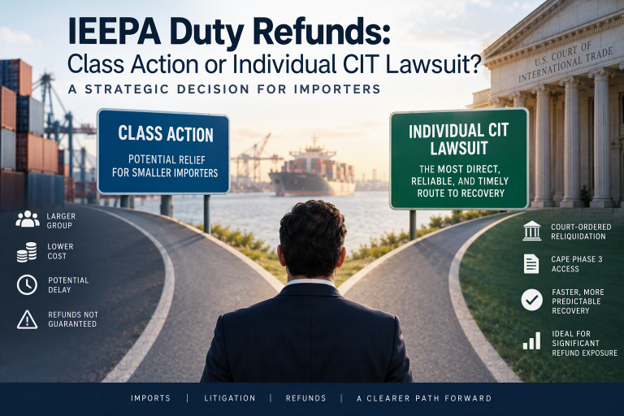
Many importers have filed preemptive cases at the Court of International Trade challenging IEEPA‑based “reciprocal” and “Fentanyl” tariffs, positioning themselves to seek refunds if the Supreme Court agrees that these duties were unlawful. With potentially tens of billions of dollars in IEEPA duties at stake, any court‑ordered refunds will almost certainly flow through CBP’s new electronic refund framework, not paper checks.
Importers that have already filed at the CIT should ensure their ACE ACH Refund Authorization is fully in place now, so that if and when refunds are ordered, payments can be issued promptly to the correct accounts—without rejections, lost interest, or avoidable delays at precisely the moment when timing and cash‑flow matter most.
Importers evaluating refund exposure in this area should also review OFW Law’s recommended strategy for importers on 2025 IEEPA tariff refunds.
What Importers Need to Do Now
1. Confirm ACH Refund enrollment in ACE: Log into the ACE Secure Data Portal and review the ACH Refund Authorization tab. Confirm that the refund recipient, U.S. bank account details, and related instructions are accurate and current. If ACH Refund is already set up correctly, document that confirmation internally so the account is ready when a refund is issued.
2. Verify designated agent instructions: If refunds are routed through a customs broker or other representative, confirm the designated agent is properly authorized in ACE and reflected correctly through CBP Form 4811 and Notify Parties. Also verify that the agent has completed ACH Refund enrollment in its own ACE account and that the refund-routing instructions still match your current arrangement.
3. Check non-resident importer setup: Non-resident importers remain subject to the electronic refund requirement. They should confirm that refund routing is fully operational now, either through a U.S. bank account enrolled directly for ACH Refund in ACE or through a properly designated U.S.-banked agent that is already ACH-enrolled.
4. Do not assume ACH Duty Payment covers ACH Refund: ACH Duty Payment and ACH Refund are separate functions in ACE. Importers that already pay duties electronically should still confirm that ACH Refund Authorization has been completed separately and tied to the correct refund recipient information.
Benefits to importers
The electronic refunds rule is intended to improve speed, security, and transparency for importers and other refund recipients.
- Faster refunds: ACH deposits typically settle within 1–2 business days, compared with the longer timeframes for mailed checks.
- Greater security: ACH significantly reduces the risk of lost, stolen, or misdirected checks.
- Operational efficiency: Electronic processing reduces manual handling and offers better visibility into refund status via ACE.
Waivers, comments, and CBP contact
Waivers from the electronic payment requirement remain available only in limited circumstances under 31 CFR 208.4 and must be requested case by case. The public comment period for the interim final rule has closed. For waiver requests or unusual refund scenarios, CBP directs stakeholders to contact the Revenue Division at [email protected].
How OFW Law can help
OFW Law assists importers, brokers, and other trade stakeholders in understanding and implementing CBP’s electronic refund requirements.
Services can include:
- Evaluating your ACE account structure, user access, and governance around refund receipt.
- Guiding your team through ACH Refund Authorization setup and internal controls for banking data.
- Reviewing and optimizing Form 4811 / Notify Party designations to align refund flows with your commercial arrangements.
- Identifying legacy or pending refunds that could be affected by the transition from paper checks to ACH and advising on waiver or comment strategies where appropriate.
To minimize refund disruption and potential loss of interest after February 6, 2026, importers should complete ACH Refund enrollment as early as possible. For assistance with compliance planning, implementation, or submissions related to the interim final rule, please contact OFW Law.
Importers should treat ACH Refund enrollment and refund-routing accuracy as an immediate operational checkpoint under the rule now in effect. For assistance with compliance planning, implementation, or questions about refund procedures and related enforcement issues, please contact OFW Law.