The U.S. Supreme Court has invalidated the Trump Administration’s IEEPA-based tariffs, reshaping the legal landscape for emergency tariff authority while simultaneously triggering a new round of trade measures that importers must navigate. Below is a practical breakdown of what happened, what replaces the IEEPA tariffs, and what companies should be doing in the near term.
The Supreme Court’s IEEPA Ruling
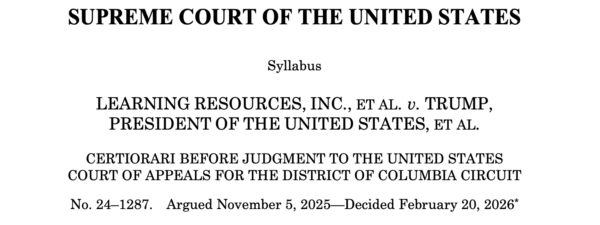
On February 20, 2026, the Supreme Court, in a 6–3 decision, struck down the IEEPA-based reciprocal tariffs on all countries and the fentanyl-related tariffs on Canada, Mexico, and China. The Court held that IEEPA’s grant of authority to “regulate…imports” during a national emergency does not extend to imposing tariffs, and that Congress is unlikely to have delegated its constitutional tax power via such open-ended language.
The majority also invoked the “major questions” doctrine, concluding that Congress must clearly and explicitly authorize actions with major economic and political significance—something IEEPA does not do for tariffs. While the Federal Circuit had cabined its earlier ruling to the specific tariffs at issue, the Supreme Court went further, stating broadly that “IEEPA does not authorize the President to impose tariffs,” with no apparent limitation to particular measures.
The Court affirmed the Federal Circuit’s decision and confirmed that the Court of International Trade (CIT) has exclusive jurisdiction over challenges to the lawfulness of IEEPA tariffs, vacating a conflicting district court ruling. Notably, the Court did not address whether, or how, importers may obtain refunds for IEEPA tariffs already paid—a gap that will drive the next wave of litigation and policy debate.
What Happens to IEEPA Tariffs and De Minimis?
Despite the ruling, IEEPA tariffs do not disappear overnight at the operational level. Until U.S. Customs and Border Protection (CBP) formally implements the Supreme Court’s decision, the reciprocal and fentanyl tariffs remain in effect in CBP’s systems. Importers must continue depositing these duties on current entries until CBP updates its programming, though post-summary corrections (PSCs) can be used to seek refunds for entries on or after February 20, 2026.
Shortly after the decision, President Trump issued an Executive Order declaring that the Executive Orders imposing IEEPA-based tariffs are no longer in effect. This action sweeps in not only the reciprocal and fentanyl tariffs, but also other IEEPA-based measures, including 40 percent tariffs on Brazil and tariffs on Russian oil. The Order directs agency heads to take all necessary steps to terminate collection of IEEPA tariffs “as soon as practicable.”
CBP followed with CSMS #67823350, signaling that it is working with other agencies to assess the implications of the Supreme Court decision and will issue technical guidance when available. At the same time, Trump issued a separate Executive Order continuing the suspension of de minimis treatment for entries under 800 dollars in value, even though that suspension had originally been embedded in IEEPA tariff orders. In other words, de minimis relief remains off the table for now.
New 10% Section 122 Tariffs and Key Exemptions
To replace lost leverage from IEEPA, President Trump has turned to Section 122 of the Trade Act of 1974, which permits temporary tariff surcharges to address balance of payments issues. A new Proclamation imposes a 10 percent surcharge on imports from all countries, effective at 12:01 a.m. EST on February 24, 2026. The Proclamation is premised on a finding that the United States faces a “large and serious balance-of-payments deficit,” and that the surcharge is needed to address it.
Section 122 limits these surcharges to 150 days, so the 10 percent tariffs will run from February 24 through 12:01 a.m. EST on July 24, 2026—unless extended by Congress. Commentators are already speculating that the Administration could allow the measure to lapse on July 24 and then restart a fresh 150-day round under the same authority.
The Proclamation includes extensive exemptions, many of which mirror existing carveouts from the now-invalid reciprocal tariffs. Among the excluded products are:
- Certain critical minerals.
- Metals used in currency and bullion.
- Energy and energy products.
- Natural resources and fertilizers that cannot be produced in the United States or are not produced in sufficient quantities to meet demand.
- Selected agricultural products, including beef, tomatoes, and oranges.
- Certain pharmaceuticals and pharmaceutical ingredients.
- Certain electronics.
- Passenger vehicles, various light, medium, and heavy-duty vehicles, buses, and certain auto parts.
- Certain aerospace products.
- All articles currently, or later, subject to Section 232 tariffs (with Section 122 applying only to portions not already covered by Section 232).
- Goods qualifying for USMCA preferential treatment.
- Textile and apparel goods qualifying for DR-CAFTA preferences.
- Informational materials, donations, and accompanied baggage.
A limited in-transit exemption applies where: (a) goods were loaded on the final mode of transit before 12:01 a.m. EST on February 24, 2026; and (b) are entered for consumption (or withdrawn from warehouse for consumption) before 12:01 a.m. EST on February 28, 2026. While the Proclamation is silent on intermodal and feeder-vessel scenarios, CBP is expected to apply the same interpretive principles used in past in-transit exemptions.
For foreign-trade zones, merchandise subject to Section 122 tariffs and admitted on or after 12:01 a.m. EST on February 24 must be admitted in privileged foreign status, which means the Section 122 surcharge will apply if those goods are later entered for consumption.
Other Tariff Tools: Section 301, 232, and 338
The Administration is also preparing to lean on other trade statutes to maintain pressure on trading partners, including Sections 301, 232, and 338. Trump has directed the U.S. Trade Representative (USTR) to initiate new Section 301 investigations targeting “unreasonable and discriminatory” foreign practices that burden U.S. commerce.
USTR Greer has signaled that these Section 301 investigations will cover “most major trading partners” and focus on:
- Pharmaceutical pricing practices.
- Trade in seafood.
- Trade in rice.
- Forced labor.
- “Industrial excess capacity.”
- Discrimination against U.S. tech firms and digital goods/services.
- Digital services taxes.
- Ocean pollution.
Although Section 301 includes procedural guardrails and requires formal findings, USTR can still move quickly, especially on an “accelerated timeframe” as described by Greer. In parallel, Trump could launch new Section 232 investigations, relying on national security to justify tariffs on additional products beyond the already broad coverage of steel, aluminum, copper, and derivative items.
Another, less-tested option is Section 338 of the Tariff Act of 1930, which authorizes duties of up to 50 percent on imports from countries that discriminate against U.S. goods. While the United States has never actually imposed tariffs under Section 338, some trade lawyers note it has functioned as a bargaining chip in negotiations.
Refunds: The Big Open Question
Perhaps the most consequential unresolved issue for importers is whether, and how, they can obtain refunds of IEEPA tariffs already paid. The Supreme Court’s decision is silent on refunds, leaving substantial uncertainty around both entitlement and mechanism.
Several paths are conceivable:
- Congress could legislate a streamlined refund mechanism and direct CBP to issue refunds administratively.
- CBP might implement its own process, though this would likely require clear statutory or judicial support.
- The CIT may take the lead, especially because it was already tasked (by the Federal Circuit) with considering nationwide relief against reciprocal and fentanyl tariffs before the Supreme Court intervened.
Now that the Federal Circuit’s decision stands, the CIT will likely revisit whether it can order nationwide relief, including directing CBP to refund tariffs for all importers, not just named plaintiffs. In addition, the CIT must resolve a variety of pending suits seeking refunds of IEEPA tariffs.
In this uncertain environment, a conservative “belt and suspenders” strategy remains prudent. Importers should:
- Monitor the liquidation status of entries on which IEEPA tariffs were paid.
- File protests on all such liquidations within 180 days, explicitly including the 40 percent Brazil tariffs and 25 percent Russian oil tariffs on India.
- Consider filing PSCs to seek refunds on unliquidated entries, pending CBP direction.
- Evaluate whether to file “me too” suits at the CIT to preserve rights in line with early litigants.
Trade Deals and Global Reactions
The decision also reverberates through the Administration’s web of bilateral and plurilateral trade arrangements, many of which were negotiated against the backdrop of IEEPA tariff leverage. Trump has stated that he expects “many” existing deals to remain intact, but has also indicated that some may be restructured using alternative authorities such as Section 122.
Trade agreements with the EU, Japan, Taiwan, and Indonesia expressly tied tariff concessions to IEEPA Executive Order 14257, now void. Nonetheless, the trade community broadly expects these agreements to survive, with the new Section 122 tariffs and coming Section 301 actions serving as replacement pressure points rather than a full reset.
Key trading partners have reacted with cautious optimism—welcoming legal clarity and the end of IEEPA tariffs, but wary of replacement measures:
- EU: European Parliament trade chair Bernd Lange called the decision a “rule of law” victory and convened a February 23 meeting to assess implications for the EU–U.S. deal, with Brussels signaling a preference for low tariffs and stability. German industry groups anticipate substitute U.S. tariffs and are urging rapid talks to restore certainty.
- UK: London expects its “privileged” low-tariff arrangement to endure, while business groups warn that Trump’s use of tools like the 1974 Trade Act could push duties higher and press for cuts on steel, aluminum, and pharma tariffs.
- Canada: Trade Minister Dominic LeBlanc has framed the ruling as a win against “unjustified” tariffs and is focused on CUSMA review and securing Section 232 relief on steel, aluminum, and autos.
- South Korea: The presidential office has pledged a comprehensive review of the ruling and U.S. responses, emphasizing alignment with the national interest.
Importers and other stakeholders should be closely tracking CBP implementation, Section 122 exemptions and in-transit rules, evolving Section 301 and 232 initiatives, and CIT activity on refunds. For tailored advice on how these developments affect your specific supply chains, you can reach out to Jessica Rifkin ([email protected]) or Denise Calle ([email protected]).