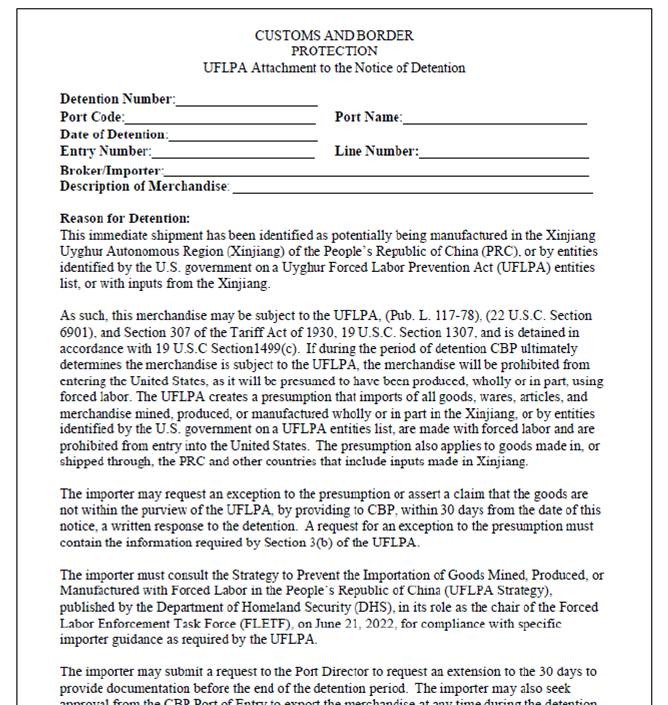
On July 31, 2026, The Department of Homeland Security (DHS), on behalf of the Forced Labor Enforcement Task Force (FLETF), announced the addition of 43 companies to the Uyghur Forced Labor Prevention Act (UFLPA) Entity List, as well as technical updates to two existing entities. Upon publication, 187 entities will be on the Entity List, a 30% increase in the number of entities listed and the single largest-ever expansion of the List.
CBP has blocked over 24,300 shipments worth nearly $1 billion under the UFLPA. This increase in targeting and enforcement is a strong signal to importers to prepare for potential future enforcement.
A shipment detained by U.S. Customs and Border Protection (“CBP”) can quickly create storage charges, delivery delays, customer issues, and supply-chain disruption. When the detention involves the Uyghur Forced Labor Prevention Act (“UFLPA”), the importer must also be prepared to address detailed questions about the origin of the goods, raw materials, suppliers, and production process.
The most important step is to act immediately. The longer a shipment remains unresolved, the greater the risk that CBP will exclude or seize the goods.
What Is a UFLPA Detention?
The UFLPA establishes a rebuttable presumption that goods mined, produced, or manufactured wholly or partly in the Xinjiang Uyghur Autonomous Region of China (“XUAR”), or produced by an entity identified on the UFLPA Entity List, were made with forced labor and are prohibited from entering the United States under Section 307 of the Tariff Act of 1930, 19 U.S.C. § 1307. CBP enforces this presumption at the border.
A detention does not necessarily mean that CBP has concluded the importer violated the law. It means CBP is withholding release while it evaluates whether the goods are admissible. However, the importer must provide sufficient information to establish either that:
– The UFLPA does not apply to the shipment; or
– The importer has overcome the UFLPA presumption with clear and convincing evidence.
The evidentiary standard is demanding. CBP may require information tracing the goods from raw materials through each stage of processing, including production steps that occurred in countries outside China.
The UFLPA Entity List is also broader than a list of companies located in Xinjiang. It may include entities that source materials from Xinjiang, participate in government labor-transfer programs, or are connected to listed entities. As a result, a shipment exported from a country such as Vietnam, Malaysia, Thailand, India, Mexico, or another third country may still receive scrutiny if CBP identifies a connection to XUAR materials or a listed entity.
What Happens After CBP Holds the Shipment?
CBP may initially place cargo on hold for inspection, testing, or additional review. Cargo selected for intensive examination may be moved to a privately operated Centralized Examination Station (“CES”), where CBP personnel conduct or coordinate the examination. Under 19 C.F.R. § 151.16, CBP generally has five days after the goods are made available for examination to release the merchandise or make a detention decision.
If CBP does not release the merchandise within the applicable five day period, the merchandise is detained by operation of law. Once a shipment is detained, CBP generally has up to 30 days after presentation for examination to release or seize the goods. If neither a release nor a determination occurs within that period, the merchandise may be deemed excluded by operation of law. See 19 C.F.R. § 151.16(b), (f). During the detention period, an importer may submit a written request to the Port Director for an extension of the 30-day period and may seek approval from the CBP Port of Entry to export the merchandise at any time during the detention process. Importers may only request a maximum of two extensions.
These deadlines make early action essential. Storage, demurrage, examination, transportation, and related charges may continue to accumulate while CBP reviews the shipment.
Request the Notice of Detention
CBP generally must issue a written Notice of Detention within five days after making a detention decision. The notice should identify the reason for the detention, the anticipated duration of the review, the nature of the examination or inquiry, and the type of information that may help CBP resolve the matter. See 19 C.F.R. § 151.16(c).
In practice, importers may receive a notice late, receive an incomplete notice, or learn about the detention only through a customs broker or freight forwarder. CBP has also implemented electronic Notice of Detention procedures through ACE for certain cargo, including UFLPA detentions. Importers should therefore monitor ACE and confirm that their broker has current contact information.
The importer should promptly obtain and review:
-
- The CBP Form 6051D or other detention notice.
-
- The entry number, bill of lading, and container information.
-
- The name and contact information for the CBP officer or office handling the detention.
-
- The specific statutory or regulatory basis for the detention.
-
- The deadline for submitting a response.
-
- Any request for documents, samples, testing, or additional information.
If the notice simply refers to “UFLPA,” the importer should ask CBP to clarify whether the issue involves XUAR origin, an entity on the UFLPA Entity List, a suspected supply-chain connection, or another forced-labor concern.
How Can an Importer Respond?
An importer should not submit a generic statement that its supplier “does not use forced labor.” CBP generally expects documentary evidence that traces the entire supply chain and addresses the specific reason for detention.
Depending on the facts, the importer may request an applicability review, argue that the shipment is outside the scope of the UFLPA, or request an exception to the rebuttable presumption. According to the CBP Forced Labor Operational Guidance for Importers, an importer may show that an exception to the rebuttable presumption should be granted by:
-
- Demonstrating compliance with importer guidance described in UFLPA Strategy
-
- responding to CBP’s inquiries for information, and
-
- Demonstrating by clear and convincing evidence that their goods are not produced, wholly or in part, with forced labor.
Potentially relevant records may include:
-
- Purchase orders, commercial invoices, packing lists, and bills of lading.
-
- Certificates of origin and manufacturing affidavits.
-
- A complete list of suppliers, manufacturers, processors, and raw-material providers.
-
- Records identifying the origin of cotton, aluminum, polysilicon, tomatoes, metals, minerals, or other high-risk inputs.
-
- Production records, bills of materials, and factory records.
-
- Transportation and warehouse records showing chain of custody.
-
- Supplier certifications, questionnaires, and contractual representations.
-
- Independent social-compliance audits and verification reports.
-
- Payroll, employment, and recruitment records, when relevant and available.
-
- Photographs, production records, and evidence identifying the location of manufacturing operations.
-
- Records showing that the importer screened suppliers against the current UFLPA Entity List.
-
- Daily manufacturing process reports
The documents must be internally consistent. A certificate of origin from the finished-goods manufacturer may not be enough if it does not address the origin of the raw materials used to make the product. CBP may require tracing through multiple tiers of production and may scrutinize indirect suppliers and sub-tier inputs.
The UFLPA Entity List Is Expanding
Importers should not assume that a prior supplier review is sufficient. DHS recently added 43 companies to the UFLPA Entity List, bringing the total number of listed entities to 187. The additions represent the largest single expansion of the list since the UFLPA was enacted and include companies involved in aluminum, apparel, copper, cotton, food, pharmaceuticals, and other sectors.
The latest additions also demonstrate that UFLPA risk is not limited to finished goods shipped directly from Xinjiang. Nineteen of the newly listed entities are located outside Xinjiang, reinforcing the importance of reviewing sourcing and corporate relationships beyond the immediate exporter.
Importers should consider reviewing:
-
- Current suppliers and manufacturers.
-
- Open purchase orders.
-
- Goods in transit.
-
- Previously approved suppliers.
-
- Raw-material and component suppliers.
-
- Affiliates, parent companies, subsidiaries, and commonly controlled entities.
-
- Supplier changes made after the goods were ordered.
-
- Any potential connection to newly listed entities.
Screening should be performed regularly because the UFLPA Entity List and other forced-labor enforcement priorities may change.
What Should an Importer Do Now?
If CBP detains your goods, the importer should:
- Confirm whether the shipment is held, formally detained, excluded, or seized.
- Obtain the written Notice of Detention and identify the response deadline.
- Ask CBP to identify the specific basis for the detention if the notice is unclear.
- Preserve all supply-chain, production, sourcing, and transportation records.
- Contact suppliers and sub-suppliers immediately for missing documentation.
- Prepare a complete, organized response addressing each CBP concern.
- Monitor storage, demurrage, and other charges while the matter remains open.
- Request additional time when appropriate, without assuming that an extension will be granted.
- Coordinate communications among the importer, customs broker, freight forwarder, suppliers, and counsel.
- Seek legal advice before submitting a rebuttal, particularly when the shipment involves an entity on the UFLPA Entity List or materials that may have originated in XUAR.
If CBP cannot resolve the detention in the importer’s favor, the goods may need to be exported, excluded, or forfeited. Once CBP issues a seizure notice, the matter generally becomes more time-consuming and expensive, and the importer may face additional administrative requirements and potential penalties.
Avoiding Future UFLPA Detentions
The best time to prepare for a UFLPA detention is before the goods are shipped. Importers should incorporate forced-labor compliance into supplier onboarding, purchasing, contracting, internal audits, and logistics procedures.
A practical compliance program should include:
-
- Routine screening against the UFLPA Entity List.
-
- Supply-chain mapping through raw-material suppliers.
-
- Written supplier representations and warranties.
-
- Audit rights and document-production requirements.
-
- Procedures for investigating supplier changes.
-
- Controls addressing commingled materials.
-
- Periodic reviews of high-risk products and geographic regions.
-
- A written response plan for CBP holds and detentions.
-
- Retention of records sufficient to establish chain of custody.
A supplier’s statement that its finished goods were manufactured outside Xinjiang may not resolve the issue if the shipment contains an input sourced from XUAR or from an Entity List company. Recent enforcement developments show that CBP is examining supply chains across borders and across multiple production tiers.
How We Can Help
Our customs, trade, and litigation team assists importers with CBP holds, UFLPA detentions, exclusion matters, seizures, protests, supply-chain documentation, and forced-labor compliance programs.
If CBP has detained or seized your goods, send us the detention notice, entry information, and any supporting documents as soon as possible. Early review can help identify the applicable response strategy, preserve the opportunity for release, reduce avoidable costs, and prevent detention from becoming a seizure or exclusion matter.
*This article is for general informational purposes and does not constitute legal advice. The applicable response will depend on the facts regarding the shipment, the contents of the CBP notice, the supply chain, and the timing of the agency’s action. *