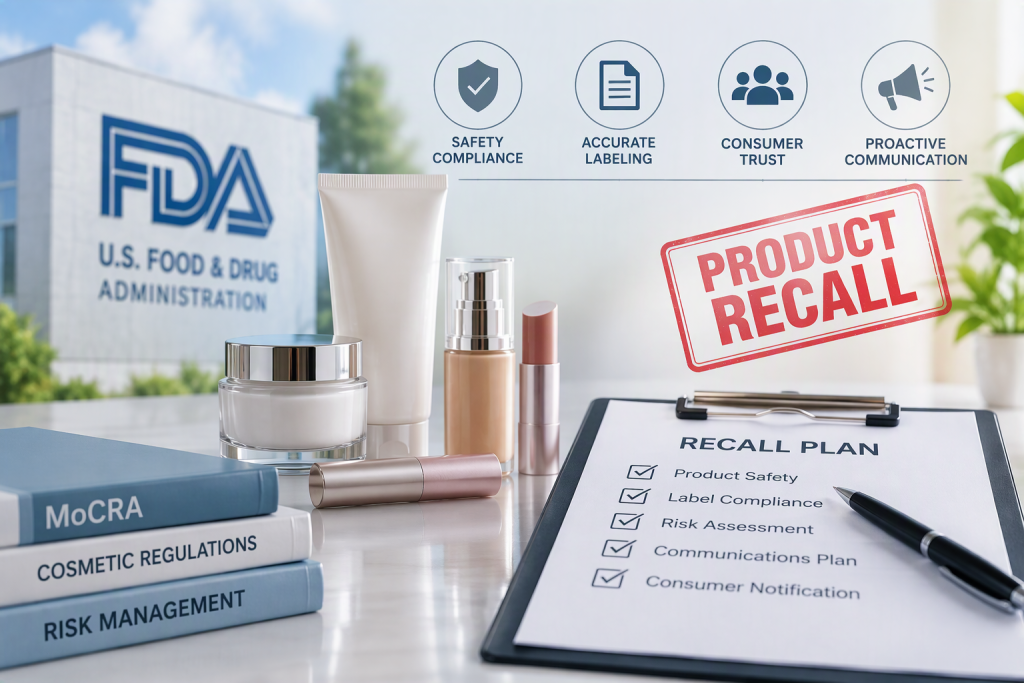
For decades, cosmetics manufacturers operated in a regulatory environment where product recalls were almost entirely voluntary. While the U.S. Food and Drug Administration (FDA) could request a recall or seek a court-ordered seizure, the agency lacked the statutory power to compel a company to pull a cosmetic product off store shelves, even when it posed significant health risks.
This gap in FDA’s authority closed with the enactment of the Modernization of Cosmetics Regulation Act of 2022 (MoCRA). MoCRA added Section 611 to the Federal Food, Drug, and Cosmetic (FD&C) Act. Section 611 of the FD&C Act granted the FDA mandatory recall authority over cosmetics for the first time ever.
In October 2026, FDA issued a final guidance titled, “Questions and Answers Regarding Mandatory Cosmetics Recalls: Guidance for Industry.” This guidance clarifies FDA’s current thinking on how the agency intends to exercise its mandatory recall power and outlines procedural protections for industry members.
Here is a breakdown of the final guidance and what your brand must do to stay compliant.
What Cosmetics are Subject to FDA’s Mandatory Recall Authority?
Under section 201(i) of the FD&C Act, the FDA’s mandatory recall authority covers virtually any personal care item applied to the human body to clean, beautify, boost attractiveness, or alter your appearance, as well as any of its raw ingredients or components. This generally encompasses makeup, hair dyes, moisturizers, cleansers, shampoos, and perfumes. The only explicit exclusion is traditional soap, as defined under 21 CFR 701.20; however, most soaps today are regulated as cosmetics.
Combination products (such as sunscreens, antiperspirants, or anti-acne washes) are classified as both drugs and cosmetics. While they aren’t subject to section 611 of the FD&C Act, they are regulated under the FDA’s separate drug recall provisions.
The Core Standard: When Can FDA Order a Mandatory Recall?
FDA cannot trigger a mandatory recall for minor labeling infractions, minor health-related events, or trivial defects. To issue an order, FDA must determine that both of the following criteria apply:
- Adulteration or Misbranding: The FDA must determine there is a reasonable probability that the cosmetic product is adulterated (e.g., contaminated, manufactured under insanitary conditions, lacking safety substantiation, containing unsafe color additives) or misbranded (e.g., false or misleading labeling) under the FD&C Act.
- Serious Adverse Health Consequences or Death (SAHCOD): The FDA must also determine that use of, or exposure to, the cosmetic will cause serious adverse health consequences or death.
Mandatory recall authority is reserved for significant public health risks rather than minor compliance oversights. However, the guidance provides a reminder that cosmetic products may be deemed misbranded for a variety of reasons. While many labeling deficiencies may not independently create a serious health risk, FDA indicates that misbranding can support a mandatory recall order if the labeling issue contributes to a situation that could result in SAHCOD.
Who Is Impacted?
The guidance applies to the “Responsible Person” (RP), which FDA identifies as the manufacturer, packer, or distributor whose name appears on the cosmetic product label. RPs are legally accountable for managing recall communications and compliance.
The Mandatory Recall Process: Step by Step
The FDA’s guidance reinforces that mandatory recall orders are a tool of last resort. The agency follows a structured multi-step process before enforcing a mandatory recall:
- Opportunity for Voluntary Recall: If the FDA identifies a qualifying risk, it gives the RP written notice outlining the hazard and providing an opportunity to voluntarily cease distribution and initiate a recall within a specified timeframe.
NOTE: A prompt, voluntary recall action with a well-managed communications plan may allow a company to shape its messaging before FDA issues its public notification. Prioritizing ownership of recall communications and acting promptly helps maintain credibility, reduce confusion, and mitigate reputational harm during a recall event. If FDA utilizes its mandatory recall authority, then FDA controls the messaging.
- Order to Cease Distribution: If the RP refuses or fails to act within the given timeframe, FDA can issue an administrative order requiring the firm to immediately stop distributing the product and notify supply chain partners.
- Right to an Informal Hearing: The company has the right to request an informal hearing (see 21 CFR Part 16). If the hearing is granted, it will be held no later than 10 days after the date of issuance of the order and address whether adequate evidence exists to justify the mandatory recall order (see Section 611(b) of the FD&C Act). If a company does not request a hearing, it waives the opportunity for a hearing and FDA will be able to proceed accordingly.
- Potential Informal Hearing Outcomes: If a hearing is granted, there are three possible outcomes at the end of a hearing:
- FDA vacates the order (drops the action if evidence is insufficient),
- FDA extends the cease-distribution order (keeps product distribution on hold until a set date), or
- FDA orders a mandatory recall (requires a full market recall complete with a firm timetable, customer notification rules, and regular progress reporting to the agency).
5. Final Recall Order: If a hearing is not requested, if a hearing is not granted, or if the FDA determines after a hearing that the order is justified, the Commissioner may convert the directive into a formal mandatory recall order. This order will establish strict timelines, press release requirements, and progress reporting schedules. The authority to issue or vacate a mandatory recall order rests solely with the FDA Commissioner and cannot be delegated down through the agency.
What Evidence Will FDA Consider?
FDA will evaluate all relevant information when assessing whether statutory criteria are met to compel a recall action. Such information includes inspectional findings, results from product or environmental sampling and testing, epidemiological evidence, consumer complaints, serious adverse event reports, and demographic information, such as whether the cosmetic product is marketed or intended for vulnerable populations like children, pregnant women, elderly, or immunocompromised consumers. This broad evidentiary approach highlights the importance of effective complaint handling, adverse event monitoring, and quality systems.
Practical Takeaways for Cosmetics Brands
To prepare for the FDA’s enforcement landscape under MoCRA, cosmetics companies should take the following steps:
- Audit Recall Plans: Ensure your standard operating procedures (SOPs) include clear protocols for responding to FDA notices within narrow timeframes (often 24 to 48 hours for initial voluntary notices).
- Establish Serious Adverse Event (SAE) Tracking: Because SAE reports can serve as primary evidence for a mandatory recall order, ensure your adverse event collection, evaluation, and reporting pipelines are robust.
- Review Safety Substantiation: Verify that every formula on the market has adequate safety testing backing its intended use, reducing the risk of an adulteration finding.
- Implement a Robust Labeling Compliance Program: Conduct routine label reviews, substantiate product claims, and maintain robust supporting documentation so that potential misbranding issues are identified and corrected promptly through voluntary action.
- Train Regulatory Response Teams: Ensure legal, regulatory, and executive teams understand company recall procedures and the FDA recall process in general. If your company receives a mandatory recall order, consult with FDA counsel to understand your options and the FDA Part 16 informal regulatory hearing process.
Final Thoughts
While the legal threshold for mandatory recalls remains high, FDA now possesses clear administrative pathways to remove dangerous cosmetics from the market if brands fail to act voluntarily. This guidance is a reminder that false or misleading labeling (including claims), product safety issues, trends of adverse event reports, and failure to act promptly can increase enforcement risk. RPs should treat recall readiness not merely as a legal precaution, but as a core component of brand safety and consumer trust.
For help with MoCRA related issues, or other enforcement matters, please reach out to Rachael Vieder Linowes ([email protected]) and Jamie Woodside ([email protected]).