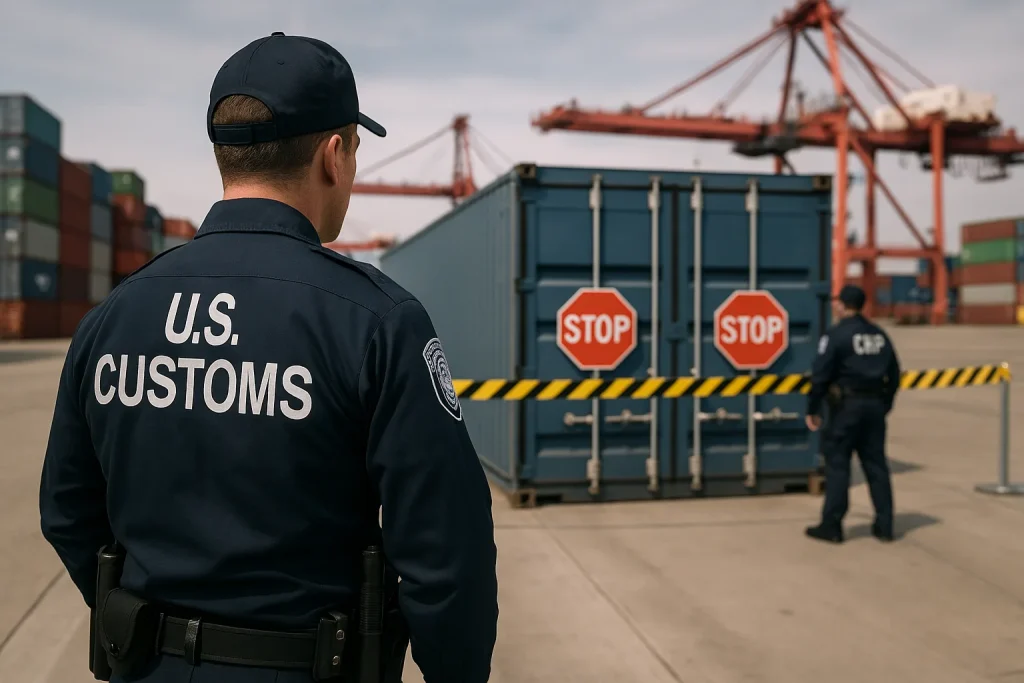
Customs compliance is changing for foreign importers of record (IORs) and the brokers who file for them. U.S. Customs and Border Protection’s interim final rule (IFR) titled “Heightened Requirements for Foreign Importers of Record” was published on November 6, 2026. It follows Executive Order 14411, “Strengthening Customs Enforcement.” The rule’s stated aims are to protect revenue, increase supply-chain transparency, and strengthen enforcement. It also relies on CTPAT validation.
This post explains who is affected, how the rule is structured, and what to do before the compliance dates.
Key dates
| Milestone | Date |
| IFR publication | November 6, 2026 |
| ABI testing begins | November 12, 2026 |
| Effective date | January 5, 2027 |
| Public comments due | January 5, 2027 |
| Broker delayed-compliance requests due | January 5, 2027 |
| Full broker compliance | May 6, 2027 |
Step 1: Is your client a US IOR?
The rule turns on three questions, in this order:
- Does the importer qualify as a US IOR?
- If not, is the foreign IOR CTPAT-validated?
- If not, is the broker handling the entry CTPAT-validated?
A US address, a US organization, or an importer number does not by itself make an importer a US IOR.
Individuals qualify if they are US citizens or lawful permanent residents. Supporting documents include a US passport, a birth certificate, a certificate of naturalization or citizenship, or a permanent resident card.
Entities must meet all of these conditions:
- They are located in the United States (the 50 states, D.C., and Puerto Rico).
- They are organized under US law.
- They maintain at all times either (a) the required US-citizen or lawful-permanent-resident beneficial ownership and control, or (b) direct ownership of a significant amount of unencumbered US real property.
For the real-property alternative, the webinar describes “significant” as the greater of 100% of the IOR’s prior-year entered value or $20 million.
A beneficial owner is a natural person who substantially controls the entity or owns or controls at least 25% of it.
Step 2: Who can file for whom?
| Importer or principal | Filing arrangement |
| Qualifying US IOR | Any licensed customs broker, or self-filing if eligible |
| CTPAT-validated foreign IOR | Any licensed customs broker, or self-filing |
| Non-CTPAT-validated foreign IOR | Must use a CTPAT-validated licensed customs broker |
When a broker acts as IOR for a principal:
- A CTPAT-validated broker may act as IOR for any principal, subject to other requirements.
- A non-CTPAT-validated broker may act as IOR only for a qualifying US principal. It must provide the principal’s identifier number, and the principal must have a CBP Form 5106 on file.
Canadian IORs are currently the only foreign IORs eligible for CTPAT.
Guidance for importers
- Classify yourself first. Test your entity against the affirmative US IOR criteria. Don’t rely on where you incorporated or where your address is.
- Build your documentation file. Organizational records include state registration, articles of incorporation, and good-standing certificates. Operations records include leases, licenses, bank statements, insurance, and warehouse evidence. Ownership records include shareholder ledgers, agreements, org charts that trace ownership to natural persons, and confirmation that there are no undisclosed side agreements.
- Document assets and encumbrances. Only the unencumbered amount counts, so keep deeds, title records, TreasuryDirect statements, and valuations.
- Plan for changes. Because eligibility must be maintained “at all times,” an ownership change after verification may require revisiting your status.
- If you’re a foreign IOR, consider whether CTPAT validation would widen your choice of brokers.
Guidance for brokers
Brokers must:
- Obtain a valid power of attorney before acting.
- Verify the principal’s claimed US IOR qualification.
- Review supporting records before making the declaration.
- Retain the POA and produce it to CBP on request.
- Retain verification records for five years.
Review provisions 19 CFR §§ 111.21, 111.29, and 141.46. together with the actual amendments.
Build an onboarding workflow that covers initial classification, document review with escalation of inconsistencies, CTPAT-status checks, POA and Form 5106 review, filing authorization, record retention, and ongoing monitoring.
ACE fields to prepare for: a US IOR indicator (“Y” or “N”), an acting-on-behalf-of indicator, and a principal identifier number. Expect ACE errors for prohibited filing arrangements and for missing or inconsistent data. Passing ACE validation does not prove the filing is legally eligible.
Delayed compliance. Brokers must request it and receive approval. Those who get relief must show satisfactory progress and good faith. Requests are due January 5, 2027, and full compliance is required by May 6, 2027. Don’t assume this relief postpones importer eligibility, CTPAT restrictions, or ACE requirements.
Enforcement exposure
The conduct includes:
- Incorrectly declaring US IOR status.
- A foreign IOR filing without the required CTPAT-validated arrangement.
- A nonvalidated broker filing for a nonvalidated foreign IOR.
- Missing or inconsistent ACE data.
- Failure to meet verification or documentation requirements.
The consequences described are live entry requirements, suspension or discontinuance of immediate-delivery privileges, penalties, and other enforcement under 19 U.S.C. §§ 1592 and 1641.
CTPAT applications: how we can help
CTPAT validation can change who may file your entries. Our team can:
- Assess eligibility: review your corporate structure, ownership, and operations to determine whether you are a US IOR or a foreign IOR.
- Evaluate CTPAT options: determine whether CTPAT validation makes sense for you or your broker.
- Prepare the application: assemble supporting records, and review security profile and documentation consistency before submission.
- Build broker compliance programs: set up verification workflows, POA and Form 5106 controls, record retention, and ACE readiness.
- Prepare delayed-compliance requests before the January 5, 2027 deadline.
- Respond to enforcement inquiries under §§ 1592 and 1641.
Open questions to watch
Several points remain unresolved in the source material:
- Which entry types are covered, and how informal entries are treated.
- Exceptions to the beneficial-owner definition.
- How prior-year entered value is calculated, and what applies to newly formed entities.
- How encumbrances and “direct ownership” through subsidiaries or trusts are treated.
- The exact scope of delayed compliance.
- The meaning of CTPAT “certified” versus “validated” status.
Next steps
Contact us to review your IOR status, broker arrangements, and CTPAT options before the January 5, 2027 effective date.
This post is for general information only and is not legal advice.