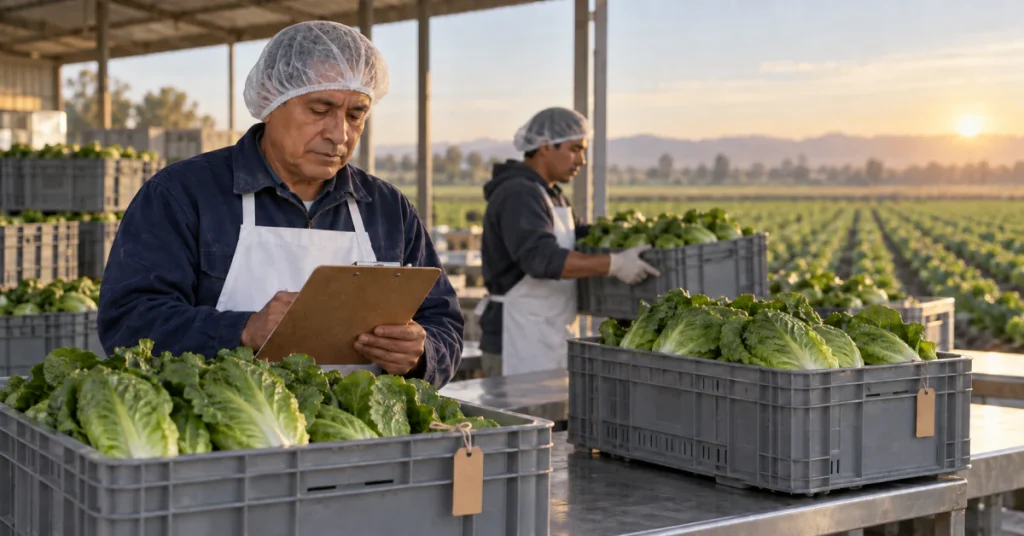
Your agribusiness operates under a compliance framework that most general attorneys do not fully understand – and that most farms still underestimate. FSMA compliance is not a checklist you complete once and file away. It is a legal and operational obligation that has shifted the food safety model in this country from reaction to prevention, and the FDA takes that shift seriously.
I work with food and agriculture businesses at OFW Law, where our team has spent decades handling FDA and USDA regulatory matters. What I see consistently is that farms and agribusinesses fall into compliance trouble not because they ignored the Food Safety Modernization Act entirely, but because they made reasonable-sounding assumptions about whether it applied to them, what records they needed to keep, and what an FDA inspection actually means for their operation. Those assumptions tend to be costly.
This article covers what FSMA compliance requires for farms and agribusinesses, which specific rules are most likely to affect your operation, how the exemption thresholds work, what FSMA 204 changes about traceability, and when it makes sense to bring in legal counsel rather than handle FDA matters on your own.
What FSMA Compliance Means for Farms and Agribusinesses
The Food Safety Modernization Act, signed into law in 2011, gave the FDA expanded authority to regulate the safety of food before a problem occurs, not just after a contamination event triggers a recall. That preventive orientation is important because it changes who bears the burden of action.
Before FSMA, food safety enforcement was largely reactive. FDA inspected, found problems, and responded. Under FSMA, farms and food facilities are expected to identify hazards, document controls, and demonstrate compliance through records that FDA can review on request. The burden has shifted to the regulated entity.
For farms, this creates a compliance picture that is more complicated than it looks. Some farms are fully covered. Some qualify for exemptions. Some are covered for certain activities and exempt for others. Many are covered but do not know it because they have never mapped their operations against the specific regulatory thresholds. And food businesses that import ingredients or finished products face a separate but connected set of requirements under the Foreign Supplier Verification Program.
The overlap between FDA and USDA jurisdiction adds another layer. Farms that grow produce are generally subject to FDA’s Produce Safety Rule. Farms that also process meat or poultry products may fall under USDA’s Food Safety and Inspection Service jurisdiction. Operations that do both need to map their activities against which agency regulates what at each stage of production – and getting that wrong creates real legal exposure.
Which FSMA Rules Matter Most to Farms
FSMA is not a single rule. It is a statute that directed FDA to create multiple regulatory frameworks, each targeting a different part of the food supply chain. The rules most relevant to farms and agribusinesses are the following.
The Produce Safety Rule
The Produce Safety Rule establishes science-based minimum standards for the safe growing, harvesting, packing, and holding of fruits and vegetables grown for human consumption. It covers agricultural water quality, worker health and hygiene, equipment and tools, and soil amendments such as compost and manure. Farms that grow covered produce for human consumption and meet certain sales thresholds are subject to this rule. Farms below specific thresholds may qualify for a full or qualified exemption, which is discussed below.
FSMA 204 and the Food Traceability Rule
Section 204 of FSMA directed FDA to establish requirements for additional traceability recordkeeping for foods the agency designated as higher-risk. The resulting Food Traceability Rule, which applies to foods on the Food Traceability List, requires covered entities to maintain records of Key Data Elements at Critical Tracking Events and to provide those records to FDA within 24 hours of a request.
The Food Traceability List includes fresh leafy greens, fresh herbs, tomatoes, peppers, melons, sprouts, cucumbers, tropical tree fruits, shell eggs, nut butters, and finfish. If your farm grows or handles any of these, FSMA 204 is directly relevant to your traceability planning.
The Foreign Supplier Verification Program (FSVP)
FSVP applies to U.S. importers of food for human or animal consumption. If your agribusiness brings ingredients, raw materials, or finished food products into the United States from foreign suppliers, you are likely an importer under FSVP – and that means you are responsible for verifying that those suppliers are producing food in a manner that provides the same level of protection as FSMA requires domestically. FSVP requires hazard analysis, supplier approval, verification activities, and records that FDA can inspect. OFW Law’s guide to importing food into the United States covers the full regulatory framework.
FSVP is often overlooked by farms and food processors who think of themselves primarily as domestic producers. If you source any component from outside the United States, this rule applies to you as the importer, regardless of your farm’s domestic compliance status.
Preventive Controls for Human Food
The Preventive Controls rule applies to registered food facilities, not farms. However, farms that do more than primary production – farms that process, pack, or hold food in a way that goes beyond the definition of “farm” under FDA regulations – may be classified as facilities subject to facility registration and preventive controls requirements. This is a common source of confusion, and the consequences of misclassifying your operation matter for your compliance obligations.
Where preventive controls apply, facilities must have a food safety plan, identify hazards, establish controls, monitor those controls, and document everything. FDA’s FSMA preventive controls rules for human food set out the specific requirements in detail. A Preventive Controls Qualified Individual, or PCQI, is responsible for overseeing the food safety plan. PCQI training is available through the Food Safety Preventive Controls Alliance.
Does FSMA Apply to Your Farm, or Are You Exempt?
This is the question I hear most often, and the answer requires more than a quick yes or no. The Produce Safety Rule includes specific thresholds that determine whether a farm is fully covered, qualifies for a partial exemption, or qualifies for a full qualified exemption. Understanding where your operation falls is foundational to everything else.
The $25,000 Sales Threshold
Farms with average annual produce sales of $25,000 or less are generally not covered by the Produce Safety Rule. This threshold is calculated using a three-year average of food sales. Farms at or below this level are not subject to the rule’s requirements, though they should document their sales figures in case FDA ever asks.
The Qualified Exemption
Farms with average annual food sales of $500,000 or less that sell more than 50 percent of their food directly to qualified end users may qualify for the qualified exemption. A qualified end user is defined as a consumer or a restaurant or retail food establishment located in the same state or within 275 miles of the farm. Farms that qualify for this exemption are subject to modified requirements rather than full compliance, including labeling or disclosure obligations but not the full set of production standards.
There are a few important caveats here that farms frequently get wrong:
- Exemptions are not automatic. You need to verify your eligibility based on actual sales data and document your qualification.
- Exemptions can be withdrawn. FDA has the authority to withdraw a qualified exemption from a specific farm if that farm is directly linked to a foodborne illness outbreak or if the farm’s food safety practices are determined to be inadequate.
- Exemptions do not eliminate all recordkeeping duties. Even farms operating under the qualified exemption retain certain documentation requirements, including records that support their exemption status.
- Commodity-specific rules still apply. Certain high-risk commodities, including sprouts, are subject to specific requirements regardless of exemption status.
What I have seen is that farms often assume exemption status without doing the underlying analysis. If FDA shows up and asks for documentation to support your exemption claim and you cannot produce it, you are in a significantly weaker position than if you had documented your eligibility properly from the start.
The Biggest FSMA Compliance Mistakes Farms and Agribusinesses Make
Years of regulatory practice in this space make certain failure patterns visible. These are the ones that create the most legal risk for farms and agribusinesses.
- Poor or incomplete recordkeeping. FSMA is a recordkeeping statute as much as it is a production standards statute. FDA cannot verify compliance without records. Farms that cannot produce documentation of their water testing, training records, or exemption status have no defense when an investigator asks. See OFW Law’s overview of common FDA compliance mistakes for more on what creates the most exposure.
- Misclassifying the operation as a farm when it is a facility. If your operation conducts activities beyond primary production – particularly if you are manufacturing, processing, packing, or holding food in a manner that exceeds the farm definition – you may be operating as a registered food facility without knowing it. That creates a separate set of compliance obligations, and operating without registration when required is a significant violation.
- Assuming the qualified exemption covers everything. As noted above, the qualified exemption does not eliminate all compliance duties. It modifies them. And it can be revoked. Treating the exemption as a permanent pass is a mistake that creates legal vulnerability.
- No traceability planning for FSMA 204 commodities. If you grow or handle any food on the Food Traceability List, you need a system for capturing and maintaining the required records now, not after FDA extends or enforces the compliance deadline.
- Missing supplier verification obligations under FSVP. Agribusinesses that import without a documented FSVP program are not compliant, regardless of how clean their domestic operation is.
- Underestimating what an FDA inspection means. An FDA inspection is not an informal visit. Investigators can review your records, collect samples, and document observations. How you respond during and after an inspection – including how you respond to a Form 483 if one is issued – matters significantly for how FDA treats your operation going forward.
FSMA 204 Changed the Traceability Conversation
The Food Traceability Rule deserves its own section because it represents the most significant expansion of traceability requirements in the history of domestic food regulation, and the compliance timeline has already changed once.
Under FSMA 204, covered entities must establish and maintain records of Key Data Elements at each Critical Tracking Event in the supply chain – from growing and receiving through processing, creating, shipping, and consuming. The goal is to give FDA the ability to trace contaminated food back to its source within hours, not weeks.
The Critical Tracking Events and Key Data Elements vary depending on where you are in the supply chain, but farms that grow FTL commodities need to capture planting, harvesting, cooling, and initial packing records that can be linked to specific lots. If you ship FTL commodities to a distributor or processor, your records need to be accurate enough that FDA could follow the product from your field to the end consumer.
In January 2025, FDA announced it was extending the compliance deadline for the Food Traceability Rule to July 20, 2028. OFW Law has published detailed coverage of FSMA compliance deadlines guidance as it has evolved. That extension reflects the scale of the implementation challenge across the food industry. It does not mean the rule is optional or that traceability preparation can be deferred.
What I tell clients is this: the extension gives you time to build a compliant system, not permission to ignore the requirement. Farms and processors that wait until 2027 to start building their traceability infrastructure will find themselves behind and under pressure. Those that start now – assessing their current recordkeeping systems, mapping their supply chain touchpoints, and identifying gaps – will be in a much stronger compliance position and will have less legal exposure if FDA asks questions in the meantime.
When Agribusinesses Call OFW Law
Most farms and food businesses do not call a regulatory attorney until something has already gone wrong. That is understandable. Regulatory counsel is not the first thing you think about when you are focused on production, supply chain, and market access. But the inflection point – the moment when legal counsel stops being optional and starts being essential – comes earlier than most operators expect.
These are the situations that typically drive agribusinesses to reach out to our food and agriculture legal team.
After an FDA Inspection
An FDA inspection of your farm or food facility is a formal regulatory event. The investigator’s observations are documented. What you say during the inspection is noted. Reviewing OFW Law’s guidance on preparing for an FDA or USDA inspection before one occurs is far less costly than managing the aftermath without preparation. If the inspection results in a Form 483 – a list of observed inspectional findings – your written response to that document shapes FDA’s assessment of your operation. A weak, incomplete, or poorly framed response to a 483 can escalate a manageable situation into a warning letter. Counsel should be involved before you respond.
After a Warning Letter
A warning letter from FDA is a serious enforcement action. It identifies specific violations, requires a corrective action response within a defined timeframe, and becomes part of the public record. Failure to respond adequately can lead to product detention, import refusal, injunctive action, or referral to the Department of Justice. These are not situations to handle without experienced FDA and USDA compliance attorneys.
When Facing Recall Exposure
Whether you are initiating a voluntary recall or responding to FDA recall pressure, the legal and reputational stakes are high. Our team has handled recall matters across the food supply chain, and the decisions made in the early hours of a recall situation have long-term consequences for your business.
When You Are Unsure About Coverage, Exemption, or Facility Status
If you are not certain whether your operation is a farm or a facility under FDA’s definitions, whether your qualified exemption is properly documented, whether you are required to register under FSMA, or whether a recent change in your operations has changed your compliance obligations, that uncertainty is worth resolving with counsel. Operating under a wrong assumption is not a defense. Our agriculture and agribusiness counsel works through applicability questions with clients regularly, and the cost of that analysis is far less than the cost of an enforcement response.
When Importing Products or Ingredients Under FSVP
FSVP compliance requires documented hazard analysis, supplier approval procedures, ongoing verification activities, and records available to FDA on request. If your agribusiness imports any food ingredient or finished product and you do not have a formal FSVP program in place, you are exposed. We help importers build FSVP programs from the ground up and help existing programs withstand FDA scrutiny.
When Building or Auditing Compliance Systems
Proactive compliance – building a defensible food safety plan, a traceability system, or a supplier verification program before FDA comes looking – is the most cost-effective kind. We advise food and agribusiness clients on preventive controls, PCQI roles and responsibilities, traceability recordkeeping under FSMA 204, and FSVP program design. If you want to know whether your current systems would hold up under an FDA audit, that is exactly the kind of assessment we do.
Why OFW Law Is a Strong Fit for FSMA Matters
OFW Law has represented food and agriculture businesses before FDA and USDA for more than four decades. Our attorneys include former agency officials who understand how FDA investigators think, how warning letters are drafted, and how the agency exercises its enforcement discretion. That institutional knowledge is not something most law firms can offer in this practice area.
Our work covers the full range of FSMA-related matters. We handle FDA and USDA compliance counseling, enforcement response, inspections, 483 replies, warning letter responses, recall matters, facility registration, FSVP program design, preventive controls guidance, and PCQI consulting. We also work on the regulatory policy side, advising clients on how to engage with FDA rulemaking and agency guidance that affects their operations. Our approach to food and agriculture compliance and risk management covers both proactive counseling and active enforcement defense.
What that means in practice is that we can support you whether you are trying to get ahead of a compliance issue, respond to an active enforcement situation, or assess whether a business decision creates regulatory exposure. You can also explore OFW Law’s work in food distribution and international trade for matters that span domestic compliance and import obligations.
FSMA Compliance FAQ for Farms and Agribusinesses
What farms are exempt from FSMA?
Farms with average annual produce sales of $25,000 or less are generally not covered by the Produce Safety Rule. Farms with average annual food sales under $500,000 that sell more than 50 percent of their food to qualified end users – consumers or food establishments in the same state or within 275 miles – may qualify for the qualified exemption. Exemption status requires documentation and can be withdrawn by FDA under specific circumstances, including a direct link to a foodborne illness outbreak.
Does FSMA 204 apply to farms?
FSMA 204, the Food Traceability Rule, applies to entities that manufacture, process, pack, or hold foods on the Food Traceability List. This includes farms that grow and pack FTL commodities such as fresh leafy greens, tomatoes, cucumbers, fresh herbs, melons, sprouts, peppers, tropical tree fruits, shell eggs, and finfish. If your farm grows or handles any FTL food, you are subject to traceability recordkeeping requirements. The compliance deadline is currently July 20, 2028.
What is the difference between the Produce Safety Rule and FSVP?
The Produce Safety Rule applies to domestic farms that grow covered fruits and vegetables for human consumption. It sets standards for growing, harvesting, packing, and holding those crops. FSVP – the Foreign Supplier Verification Program – applies to U.S. importers of food from foreign suppliers. It requires importers to verify that their foreign suppliers are producing food under conditions that provide the same level of protection as FSMA requires domestically. The two rules apply to different activities: one governs domestic production, the other governs import compliance.
What records do farms need to keep for FSMA compliance?
Record requirements vary by which FSMA rules apply to your operation. Under the Produce Safety Rule, covered farms typically need to maintain records of agricultural water testing, training, and practices related to soil amendments, wildlife, and equipment. Farms subject to FSMA 204 must maintain traceability records – Key Data Elements at Critical Tracking Events – for FTL foods. Farms claiming a qualified exemption should document the sales data and distribution patterns that support their eligibility. All records must be available for FDA review upon request.
When should an agribusiness call an attorney about FSMA?
The clearest triggers are an FDA inspection, a Form 483, a warning letter, or any situation involving potential recall. Beyond those enforcement events, it is worth consulting with a food safety attorney when you are unsure about your operation’s coverage status, when you are building or revising compliance programs, when you have experienced a change in operations that might affect your regulatory classification, or when you are importing food products and lack a formal FSVP program.
What happens after an FDA inspection or warning letter?
After an inspection, FDA may issue a Form 483 listing inspectional observations. Your written response to a 483 – typically due within 15 business days – shapes how FDA proceeds. A well-documented, specific response that addresses each observation and commits to concrete corrective actions can prevent escalation. A poorly constructed response, or no response, typically results in a warning letter. After a warning letter, FDA expects a substantive corrective action plan and may conduct a follow-up inspection to verify implementation. Failure to achieve adequate correction can lead to more severe enforcement including import alerts, product seizure, injunctions, or consent decrees.
FSMA Compliance Is Operational and Legal Risk Management
If there is one thing I want farms and agribusiness operators to take from this article, it is that FSMA compliance is not separate from your business risk. It is part of it. The rules governing produce safety, traceability, import verification, and preventive controls are not bureaucratic paperwork exercises. They are the framework FDA uses to assess whether your operation is safe and whether it is operating within the law.
Many farms fall into a gap where they are technically covered by FSMA requirements but have never formally assessed their obligations. That gap creates exposure, and it closes slowly over time as FDA expands its inspection capacity, the Food Traceability Rule approaches its compliance deadline, and enforcement trends continue to develop.
If you need help assessing whether FSMA applies to your operation, building a compliance program that will hold up under FDA scrutiny, responding to an inspection finding or warning letter, or preparing your traceability systems for FSMA 204 obligations, OFW Law can help. You can reach our team directly through the contact page at ofwlaw.com. The earlier in a compliance challenge you bring in experienced counsel, the more options you have.