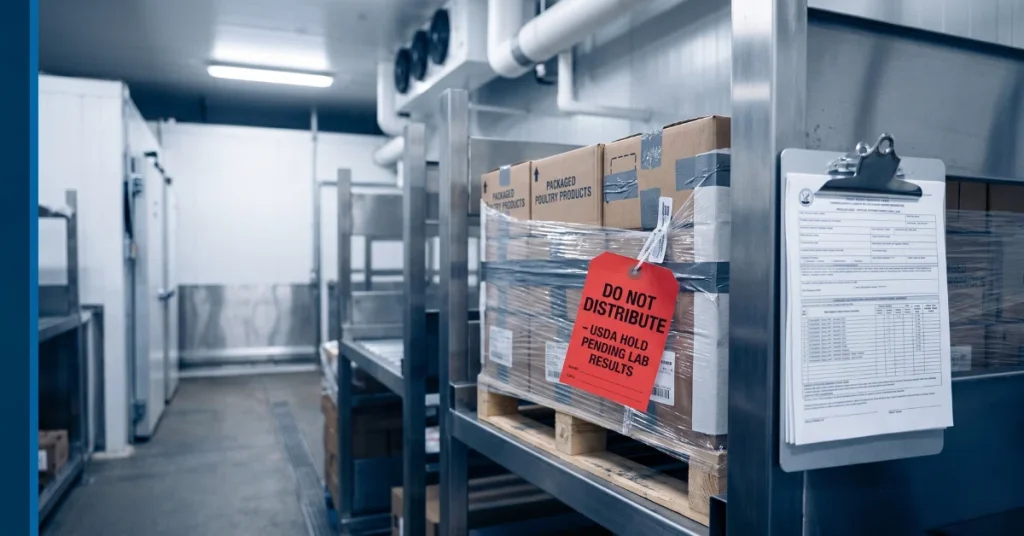
FSIS test and hold is the mandatory federal requirement that food establishments and importers of record retain control of any product sampled by the Food Safety and Inspection Service and prevent that product from entering commerce until FSIS confirms negative laboratory results.
When FSIS places your product under test and hold, the decisions your establishment makes in the next 24 to 48 hours determine whether this becomes a routine compliance event or a full-scale enforcement action. Businesses searching for answers on FSIS test and hold are often already mid-situation – with product sitting on a loading dock and inspectors on the floor.
This guide covers the current FSIS test-and-hold framework, the enforcement chain from initial sampling through Notice of Intended Enforcement (NOIN), and the steps food establishments and importers must take to protect their operations. Understanding the policy is the first step toward a defensible response.
What the FSIS Test-and-Hold Policy Requires
The FSIS test-and-hold policy became mandatory on February 8, 2013, after years of voluntary guidance that many establishments failed to follow. Under the Federal Register final rule (Docket No. FSIS-2005-0044), all official establishments and importers of record must maintain control of product sampled for adulterants by FSIS and must not allow that product to enter commerce until negative test results are received.
Before this rule, FSIS encouraged but did not require companies to hold products pending test results. The predictable outcome was a pattern of product recalls after positive results were found in items already distributed to retailers and consumers. FSIS adopted the mandatory framework specifically to eliminate recalls caused by companies’ failure to retain product during testing.
There is one critical limitation. The policy applies only to FSIS-conducted testing for adulterants – not to testing performed by the establishment itself. FSIS continues to recommend that all facilities hold products pending their own internal testing, but that recommendation carries no enforcement mechanism.
Which Adulterants and Products Are Covered
The test-and-hold requirement applies across a defined set of pathogens, product types, and contaminants. If FSIS samples your product for any of the following, the hold obligation activates immediately.
| Product Category | Covered Adulterants |
|---|---|
| Ready-to-eat (RTE) meat and poultry products | Salmonella, Listeria monocytogenes, E. coli O157:H7, non-O157 STEC |
| Raw non-intact beef products | E. coli O157:H7 and six non-O157 STEC strains |
| Food contact surfaces in RTE environments | Listeria monocytogenes |
| Livestock (carcasses and organs) | Veterinary drug residues and carbadox residues |
| Any FSIS-regulated product | Economic adulterants (species substitution, undeclared ingredients) |
Establishments subject to USDA and FSIS compliance obligations should know that the adulterant list above reflects FSIS’s current testing priorities. The agency periodically updates its sampling programs and target pathogens through directives and Federal Register notices.
How FSIS Test and Hold Works in Practice
The operational mechanics of FSIS test and hold are straightforward in theory but create real logistical pressure for establishments running continuous production lines. Here is the sequence from the moment an FSIS inspector collects a sample.
- FSIS inspector collects the sample during routine verification activities or as part of a targeted sampling program. The establishment is notified that a sample has been taken.
- Product must be held under establishment control. The establishment must prevent the sampled product – and in some cases, related production lots – from entering commerce. Physical segregation, company seals, or equivalent control measures must be in place.
- Pre-shipment review cannot be completed. Under 9 CFR 417.5(c), completion of the pre-shipment review signals that product is ready to enter commerce. Establishments must not complete this review until negative FSIS test results are received.
- Product may be relocated – but only under control. Product can move to a different facility during the hold period, provided the establishment maintains adequate safeguards such as company seals and chain-of-custody documentation.
- Negative results release the hold. Once FSIS confirms negative results, the establishment may complete the pre-shipment review and release product into commerce normally.
Companies that already maintain strong product hold procedures will find the transition smoother. The key is having written protocols that your production team can execute immediately – before the results come back, not after a positive finding forces a crisis response.
Your inspection readiness checklist should include test-and-hold protocols as a standing item, not a situational add-on.
The Enforcement Escalation From Positive Test to NOIN
When test results come back positive – or when FSIS determines that an establishment violated the hold requirement – the enforcement response follows a defined escalation path. Each step narrows the establishment’s options and increases the stakes.
| Stage | FSIS Action | Establishment Impact |
|---|---|---|
| 1. Positive test result | FSIS notifies establishment of confirmed positive finding | Product must be condemned, reprocessed, or diverted per FSIS instructions |
| 2. Noncompliance Record (NR) | Inspector issues a formal NR documenting the violation | Establishment must respond with corrective and preventive actions |
| 3. Notice of Intended Enforcement (NOIN) | FSIS District Office issues written notice of planned enforcement action | Establishment has limited time to respond before suspension takes effect |
| 4. Inspection suspension | FSIS withdraws inspection personnel from the facility | Operations halt – no product can be produced or shipped without federal inspection |
| 5. Recall request | FSIS requests voluntary recall of product already in commerce | Public notification, product retrieval, and brand damage |
| 6. Criminal referral | FSIS refers the case to USDA Office of Inspector General | Potential criminal prosecution under the Federal Meat Inspection Act or Poultry Products Inspection Act |
The critical window is between stages 2 and 3. Once FSIS issues a NOIN, the establishment’s ability to resolve the situation without operational disruption shrinks dramatically. Companies that wait until they receive a NOIN before contacting legal counsel are already behind.
A pattern of noncompliance records accelerates the escalation timeline. FSIS tracks NR history through the Public Health Information System (PHIS) and uses that data to prioritize enforcement resources. One NR may result in increased verification activities. A series of NRs signals systemic failure and triggers district-level review.
Consequences of Shipping Product Under Hold
Critical Warning
Shipping FSIS-sampled product without adequate controls constitutes shipping uninspected and potentially adulterated product under the Federal Meat Inspection Act. This is not a minor paperwork issue – it triggers the full enforcement escalation described above, beginning with immediate inspection suspension.
The consequences for violating the test-and-hold requirement are severe because FSIS treats the violation as a fundamental food safety failure, not a procedural lapse.
- Inspection suspension – FSIS can suspend inspection at your facility, halting all production and shipment. No product moves without federal inspection.
- Mandatory recall – If product entered commerce before negative results were confirmed, FSIS will request a recall regardless of whether the test ultimately comes back positive or negative.
- NOIN and formal enforcement – The establishment receives formal notice of FSIS’s intent to take enforcement action, triggering a compressed response timeline.
- Criminal liability exposure – Willful violation of hold requirements can result in referral to the USDA Office of Inspector General for criminal investigation.
- Downstream commercial damage – Retail and foodservice buyers monitor FSIS enforcement actions. A suspension or recall creates lasting procurement risk beyond the immediate regulatory event.
Establishments that face FSIS compliance visits or surveillance activities should treat any sampling event as a trigger for their hold protocol – not as a routine inspection step that can be managed informally.
How OFW Law Defends Establishments Facing FSIS Enforcement
OFW Law’s USDA and FSIS practice represents food establishments, importers, and processors at every stage of the enforcement chain – from the initial test-and-hold event through NOIN response, inspection suspension appeals, recall negotiations, and administrative hearings.
The firm’s approach to FSIS enforcement defense focuses on three priorities.
- Immediate response strategy. When your facility receives notice of a positive test result or a hold violation, the first 48 hours define the trajectory. OFW Law’s team works with establishment management to assess the scope of the event, preserve critical documentation, and prepare the corrective action response before the enforcement escalation reaches the NOIN stage.
- HACCP and food safety system defense. Most FSIS enforcement actions hinge on whether the establishment’s HACCP plan, prerequisite programs, and sanitation SOPs were adequate and properly implemented. John Dillard and the USDA practice team have decades of experience defending these systems against FSIS allegations of inadequacy.
- Regulatory negotiation and resolution. Not every positive test result must lead to a suspension or recall. When the establishment’s compliance history, corrective actions, and food safety systems support it, there are opportunities to resolve enforcement events at earlier stages – before operational disruption occurs.
The earlier legal counsel is involved, the more options remain available. An attorney who understands FSIS enforcement procedures can identify weaknesses in the agency’s position, prepare documentation that addresses FSIS’s specific concerns, and negotiate outcomes that protect both public health and business continuity.
Frequently Asked Questions About FSIS Test and Hold
What happens after FSIS takes a sample for testing?
After FSIS collects a sample, the establishment must hold all sampled product under its control and cannot complete the pre-shipment review until negative results are received. Results typically take 24 to 72 hours depending on the pathogen and testing method. During this period, the product can be moved to another facility under adequate safeguards but cannot be released into commerce.
How long does an FSIS test-and-hold last?
The hold lasts until FSIS confirms negative test results. For most pathogen testing, this is 24 to 72 hours. However, if the initial screen triggers confirmatory testing – particularly for STEC serotypes – the hold can extend to five or more business days. There is no fixed statutory time limit. The hold ends when the agency releases the results.
Can I move products to another facility during a test and hold?
Yes, but only under maintained control. The establishment must use company seals or equivalent safeguards and maintain chain-of-custody documentation showing the product remained under control throughout the transfer. The receiving facility must also understand that the product is under hold and cannot enter commerce until cleared by FSIS.
What happens if I ship product before FSIS test results come back?
Shipping product before receiving negative FSIS test results constitutes shipping uninspected and potentially adulterated product. FSIS treats this as a serious violation that can trigger immediate inspection suspension, a mandatory recall, and referral for criminal investigation. The consequences apply regardless of whether the test ultimately comes back negative.
What is the difference between an FSIS test-and-hold and a retain tag?
A test-and-hold arises when FSIS samples product for adulterant testing and the establishment must hold product pending results. A retain tag is a physical tag placed by an FSIS inspector on specific product that the agency has determined may be adulterated or misbranded. Violating either type of hold carries serious enforcement consequences, but a retain tag typically involves product FSIS has already identified as potentially noncompliant.
When should I contact an attorney about an FSIS enforcement action?
Contact a regulatory attorney as soon as you receive a positive test result, a pattern of noncompliance records, or any indication that FSIS is considering formal enforcement action. The window between a Noncompliance Record and a NOIN is when legal counsel can have the greatest impact on the outcome. Waiting until after a NOIN is issued significantly limits your response options.
What does FSIS stand for?
FSIS stands for the Food Safety and Inspection Service, the public health agency within the United States Department of Agriculture responsible for ensuring the safety of domestic and imported meat, poultry, and processed egg products. FSIS operates through in-plant inspectors stationed at federally regulated establishments and enforces requirements including the test-and-hold policy through its district offices and the Office of Field Operations.
Is FSIS test-and-hold the same as a USDA customs hold?
No. An FSIS test-and-hold applies when FSIS samples a product for adulterant testing at a domestic establishment or import inspection facility, and the product must be retained pending laboratory results. A USDA customs hold or APHIS hold applies to imported agricultural products detained by Customs and Border Protection or the Animal and Plant Health Inspection Service for phytosanitary or animal health screening. The agencies, legal authorities, and release procedures are different. If your hold involves FSIS sampling at a federally inspected establishment, the test-and-hold framework described in this guide applies.
This article is for informational purposes only and does not constitute legal advice. Consult a qualified attorney about your specific situation. For questions about FSIS test-and-hold policy or enforcement defense, contact the OFW Law team.
Facing an FSIS Enforcement Action?
OFW Law’s USDA and FSIS practice defends food establishments at every stage of the enforcement chain. Contact us to discuss your situation.